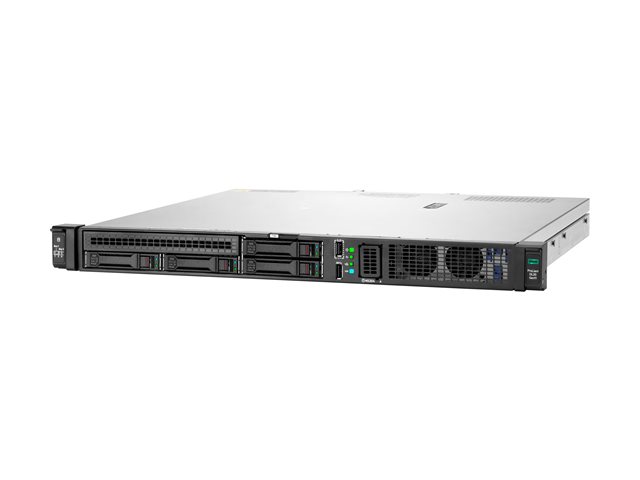
The HPE ProLiant DL20 Gen11 is a 1U rack-mounted server built around a single Intel Xeon E-2436 processor. It is a compact, entry-to-midrange server aimed at businesses that need reliable on-premises compute but do not have the space, budget, or workload profile to justify a larger multi-processor system.
What it is not is a compromise machine. The E-2436 is a 6-core processor with a maximum turbo speed of 5 GHz and 18 MB of cache — a meaningful step up from older-generation Xeon E entry servers, and more than capable of handling the workloads that typically land on a server at this tier. Pair that with 32 GB of DDR5 SDRAM installed as standard — expandable to 128 GB — and you have a platform that handles virtualisation, file serving, and line-of-business applications without breaking a sweat.
The server weighs 9 kg and is part of HPE's Smart Choice programme, which means it is a pre-configured build designed for straightforward procurement and fast deployment rather than a heavily customised build-to-order.
How the Specifications Translate into Real-World Performance
Specification sheets can obscure as much as they reveal, so it is worth translating a few key numbers into practical terms.
DDR5 memory at 32 GB installed, expandable to 128 GB. DDR5 is the current generation of server memory, offering higher bandwidth and improved power efficiency over DDR4. At 32 GB installed, this server handles typical SME workloads — virtualised environments running two or three VMs, SQL databases, email services — without memory becoming the bottleneck. The 128 GB ceiling gives meaningful runway for businesses whose needs grow over time.
Intel Xeon E-2436 at up to 5 GHz turbo, with 18 MB cache. The 6-core architecture handles parallelised workloads well. The 5 GHz turbo speed matters in single-threaded scenarios — legacy applications, certain database query types — where raw clock speed still drives responsiveness. The 18 MB cache reduces latency on frequently accessed data, which is relevant for any workload involving repeated reads from structured datasets.
4 x Gigabit Ethernet ports. Four onboard network ports give IT teams options: dedicated management traffic, separate iSCSI or backup connections, link aggregation for redundancy, or simple separation of production and administrative networks. For a server at this scale, four GbE ports is a well-considered allocation.
4 hot-swap 2.5" SFF bays with SATA 6Gb/s. Hot-swap bays mean storage can be replaced without powering the server down — relevant for environments where uptime matters. The SATA 6Gb/s interface supports modern SSD speeds. This configuration ships with two 480 GB SATA SSDs included, with two additional bays available for expansion.
Security and Manageability
For businesses operating under compliance frameworks — or those pursuing Cyber Essentials certification — the DL20 Gen11's security features are worth noting. The server includes a Trusted Platform Module (TPM) security chip, which provides hardware-based cryptographic key storage and supports secure boot processes. This is a foundational requirement in environments handling sensitive data, and increasingly expected by cyber insurance underwriters.
Remote management capability means the server can be monitored, rebooted, and administered without requiring physical access — a practical necessity for businesses where the IT function is lean or where the server is hosted off-site. The hot-plug power supply also contributes to availability, allowing the power unit to be serviced without a planned outage.
Where This Server Fits in a UK SME's Infrastructure
- Branch office or secondary site serve — compact footprint, straightforward management, sufficient compute for local file services or a virtualised workload.
- Dedicated application server — a single line-of-business application running on its own hardware, isolated from the wider environment.
- Edge or remote location compute — the server's operating temperature ceiling of 35 °C and relatively modest physical footprint suit environments that are not purpose-built data centres.
- SME primary server — for businesses running modest virtualised workloads, a small SQL instance, or a hosted communications platform, the DL20 Gen11 provides the right balance of performance and simplicity without the operational overhead of a larger platform.
It is worth being direct about what this server is not designed for: large-scale virtualisation clusters, memory-intensive analytics workloads running against multi-terabyte datasets, or environments requiring more than two populated memory channels. Those scenarios call for a different platform. For the workloads described above, the DL20 Gen11 is a well-matched, deployable-today solution.
Apaxon is an HPE authorised partner and Manchester-based managed IT provider, supplying rack servers and enterprise hardware across the UK alongside managed IT services, infrastructure deployment, and Cyber Essentials-backed cybersecurity support.
The product covered in this post
Get the latest IT insights
Expert tips, infrastructure news, and product updates — delivered weekly.